Investing in a 21 inch subwoofer professional enclosure delivers massive sub-30Hz output, but buying without auditing mechanical limits, power requirements, and transport dimensions leads to costly operational failures. This engineering checklist outlines essential criteria for excursion, electrical demands, cabinet types, and crossover integration so you can choose the right professional 21 inch subwoofer for PA systems.
Checklist 1: Transducer Excursion (Xmax) and Motor Strength (BL)
A high-performance 21 inch subwoofer professional transducer must feature a long linear excursion (Xmax) and a massive voice coil to move air without mechanical bottoming out or thermal compression. When reproducing deep sub-bass below 35Hz, a speaker cone must travel extended physical distances to generate audible acoustic energy. If an enclosure uses a budget driver with an Xmax under 12mm, high-energy musical passages will push the voice coil past its magnetic gap, causing distortion, physical damage, and eventual failure.
A tour-grade 21 inch PA subwoofer requires a verified linear mathematical Xmax of 15mm to 20mm, alongside a peak-to-peak mechanical limit (Xmech) exceeding 50mm. This mechanical travel must be backed by a strong motor assembly, measured by its force factor (BL). Because a 21-inch cone has a heavy moving mass (Mms) often exceeding 350 grams, weak ferrite magnets lose physical control over the diaphragm during rapid transients.
Examine the voice coil diameter and thermal dissipation design:
1. Voice Coil Dimensions: Look for a minimum 4.5-inch (115mm) or 5.3-inch (135mm) inner/outer wound copper or aluminum voice coil to handle high electrical power safely.
2. Forced-Air Cooling: Ensure the motor structure includes multi-vented pole pieces and radial chassis cooling fins to pull heat away from the gap during sustained high-SPL sets.
3. Triple-Roll Surrounds and Silicone Spiders: The suspension components must maintain linear centering even under continuous heavy loads.
Prioritizing these transducer parameters ensures that your large venue concert subwoofer 21 inch investment maintains clean transient punch without thermal burnout during multi-hour outdoor festivals.
Checklist 2: Amplifier Headroom and AC Mains Power Demands
Driving a 21 inch subwoofer professional system requires massive continuous amplifier power backed by a stable, high-current electrical infrastructure. High-output 21-inch transducers are typically rated between 1500W and 3000W AES continuous power handling into 4-ohm or 8-ohm loads. To reproduce dynamic transients such as bass drops or live kick drum strikes without amplifier clipping, your power amplifier must deliver 1.5 to 2 times the driver’s continuous rating.
This introduces serious electrical current demands on site. Standard 15-amp or 20-amp, 120V wall circuits cannot supply the sustained current needed for banks of high-wattage amplifiers running heavy bass. When multiple amplifiers pull heavy current during sub-bass hits, undersized electrical circuits suffer line voltage drop:
a. Amplifier Rail Sag: Inadequate AC current causes internal amplifier power supplies to sag, transforming tight bass notes into mushy, distorted rumble.
b. Nuisance Breaker Trips: High current spikes from dynamic kick drums frequently trip electrical breakers, shutting down the entire sound system during an event.
c. Power Factor Correction (PFC): For reliable performance, select touring amplifiers equipped with active Power Factor Correction and universal regulated power supplies that draw current smoothly from 208V–240V multi-phase industrial drops or generators.
Before deploying a high SPL 21 inch live sound subwoofer, verify that your venues can provide dedicated 32-amp or 63-amp power distribution. Underpowering or starving a 21-inch cabinet of electrical current is the fastest way to induce square-wave clipping, which overheats voice coils and leads to driver failure.
| Cabinet Design Architecture |
Usable Low-End Limit (-3dB) |
Acoustic Throw Distance |
Physical Enclosure Volume |
Transient Punch Fidelity |
| Bass-Reflex (Direct Radiating) |
30 Hz – 35 Hz |
Medium (Near to Mid-field) |
Moderate (Compact footprint) |
Excellent (Natural, musical impulse) |
| Folded Horn / Hybrid Loaded |
25 Hz – 32 Hz |
Very Long (Far-field projection) |
Very Large (Heavy, deep footprint) |
High impact (Slight group delay) |
| Bandpass (Order 6 / Order 8) |
28 Hz – 40 Hz |
Medium to Long |
Large (Complex internal baffles) |
Good (High SPL within a narrow band) |
Checklist 3: Cabinet Design: Bass-Reflex, Horn-Loaded, or Bandpass?
Choosing the right cabinet design for a 21 inch subwoofer professional enclosure depends on whether your venue needs deep acoustic extension or long-throw outdoor projection. The physical construction of the enclosure dictates how efficiently the driver couples with room air and shapes the resulting low-frequency transient behavior.
A direct-radiating bass-reflex configuration is the most versatile 21 inch subwoofer enclosure type. It features large, computer-tuned laminate ports that maximize airflow while minimizing port turbulence and chuffing noise. Bass-reflex boxes deliver smooth, natural frequency response from 30Hz up to 80Hz, making them an ideal foundation for clubs, concert theaters, and multi-genre rental inventories.
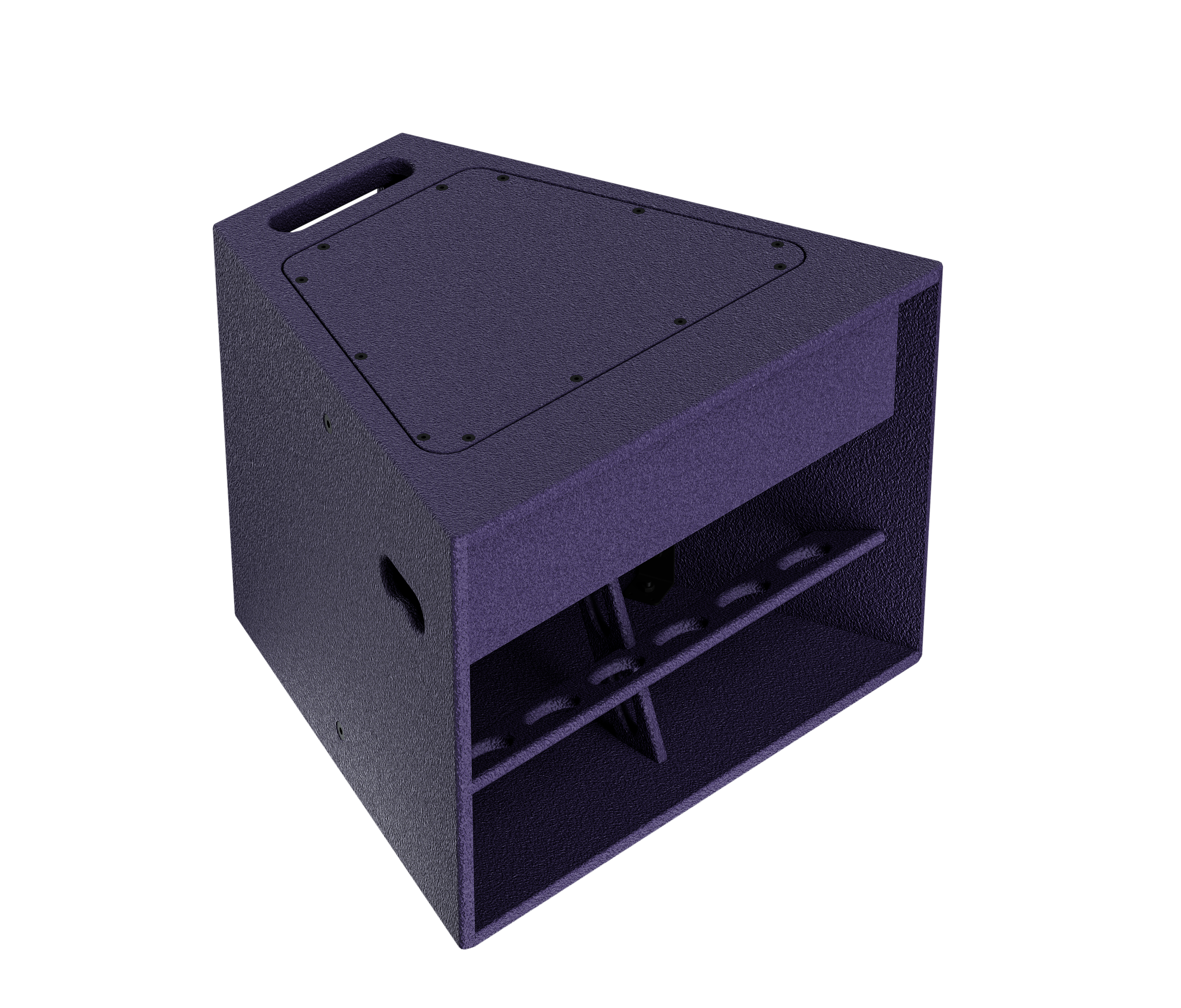
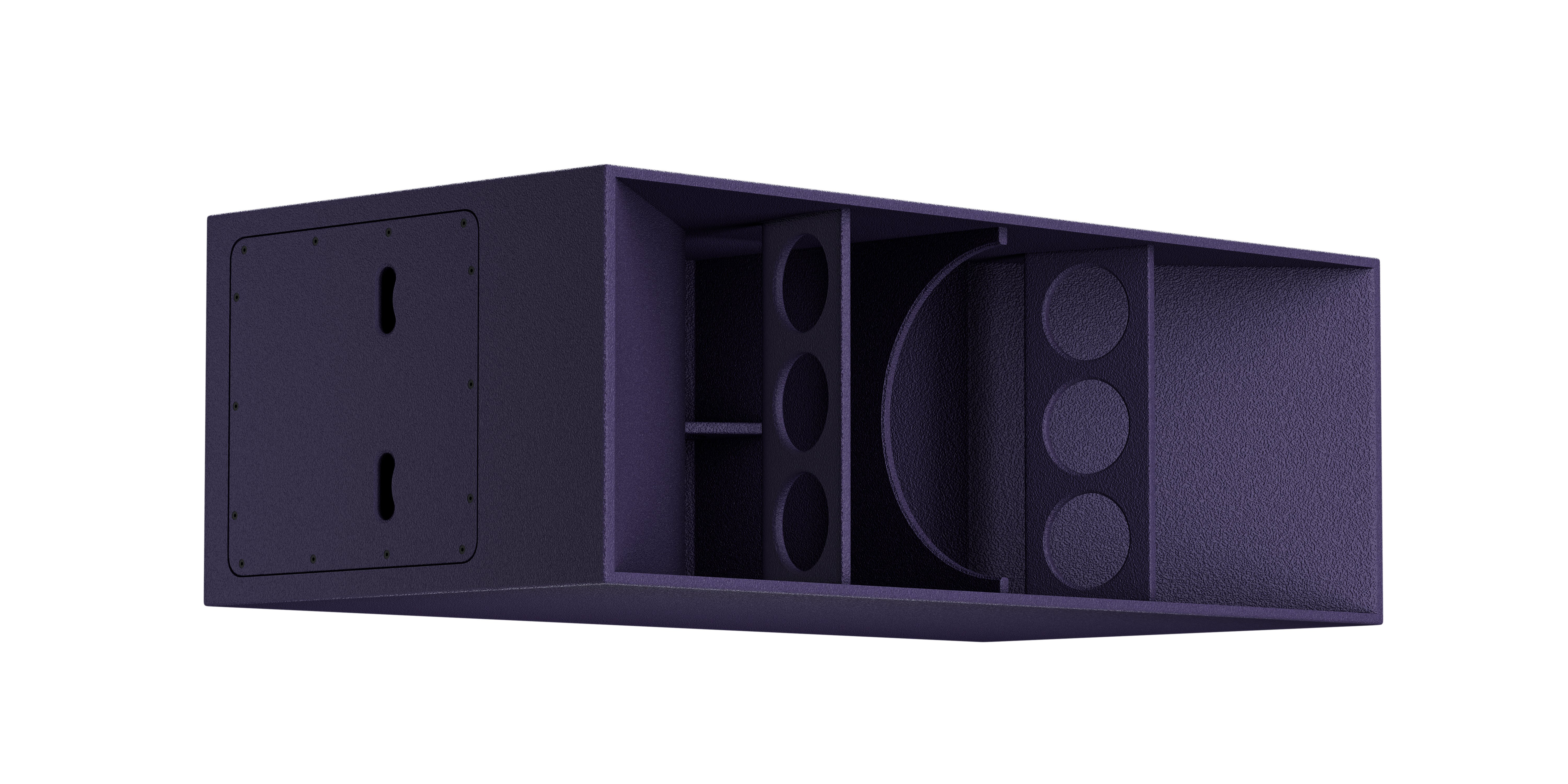
For massive outdoor festivals and stadium touring, folded-horn or horn-loaded hybrid enclosures provide superior forward throw and higher electro-acoustic efficiency. The horn throat compresses air at the driver cone and gradually expands it, projecting low-frequency wavefronts across distances exceeding 50 meters. However, horn enclosures feature larger cabinet dimensions and heavier weights, making them less practical for smaller venues or single-truck mobile crews.
Checklist 4: Crossover Integration: Avoiding the "Slow Bass" Trap
A 21 inch subwoofer professional cabinet must be low-passed below 70Hz to 80Hz to prevent sluggish transient response from muddying the mid-bass vocal range. The misconception that large-diameter subwoofers produce "slow, sloppy bass" stems directly from improper crossover calibration. Because a 21-inch cone has greater moving mass than a 15-inch or 18-inch driver, its upper mechanical limit loses efficiency above 80Hz.
If you attempt to cross a 21-inch cabinet over at 120Hz to meet compact 8-inch PA tops, the heavy cone struggles to reproduce those upper frequencies cleanly, introducing phase smearing and a hollow sound. For optimal system coherence:
1. Deploy as an Infra-Sub: Use the professional 21 inch subwoofer for PA systems as an ultra-low frequency engine operating strictly between 28Hz and 65Hz.
2. Implement Steep Filter Slopes: Apply 24dB/octave or 48dB/octave Linkwitz-Riley low-pass filters in your system DSP to eliminate out-of-band harmonics.
3. Align Phase and Group Delay: Apply digital delay to align the physical acoustic centers of your 21-inch subwoofers with your mid-high line array boxes, ensuring that sub-bass frequencies and mid-bass punch hit the audience in phase.
Checklist 5: Physical Logistics: Truck Pack, Rigging, and Clearance
Before investing in a 21 inch subwoofer professional system, verify truck-pack dimensions, wheel placement, and venue door clearance to avoid severe transport bottlenecks. A professional-grade 21-inch cabinet weighs between 75kg and 115kg and measures nearly a cubic meter in volume. Without proper transport planning, moving these enclosures through tight spaces creates safety risks and increases crew fatigue.
Ensure the cabinet features standardized truck-pack dimensions designed to fit neatly across standard freight trucks and cargo vans. High-grade Baltic birch enclosures should include heavy-duty, blue polyurethane swivel casters mounted to a protective rear wheelboard, allowing one technician to roll the cabinet over venue thresholds. Multiple ergonomic steel handles placed at balanced center-of-gravity points are also essential for safe, efficient lifting.
Manufacturing Precision: Why LASE SOUND Delivers Reliable 21-Inch Power
Engineering dependable high-excursion sub-bass enclosures demands advanced acoustic modeling, precision wood construction, and rigorous thermal testing. Heavy sub-bass energy subjects loudspeaker joints and internal baffles to continuous structural stress. Poorly reinforced cabinets built from inferior materials rattle apart and leak acoustic energy through flexing walls.
This is where LASE SOUND provides proven touring solutions. Operating from a 13,500㎡ modern manufacturing facility staffed by 286 acoustic specialists and serving clients across 100+ countries, LASE SOUND manufactures professional-grade subwoofers engineered for demanding live sound applications. Utilizing CNC-machined birch plywood, durable polyurea finishes, and precision-matched motor components, LASE SOUND subwoofers deliver transparent, high-output sub-bass that audio engineers can depend on night after night.
Make an Informed Professional Subwoofer Investment
Purchasing a 21 inch subwoofer professional enclosure can elevate your sound system with clear, effortless sub-bass that smaller formats cannot match. By auditing driver excursion limits, verifying venue electrical capacity, selecting the proper cabinet design, and planning transport logistics, you ensure that your investment performs reliably without downtime.
Contact LASE SOUND today to discuss your venue dimensions, review power matching specifications, and discover tour-grade 21-inch subwoofer systems engineered to handle demanding live sound environments.


 EN

 Hot News