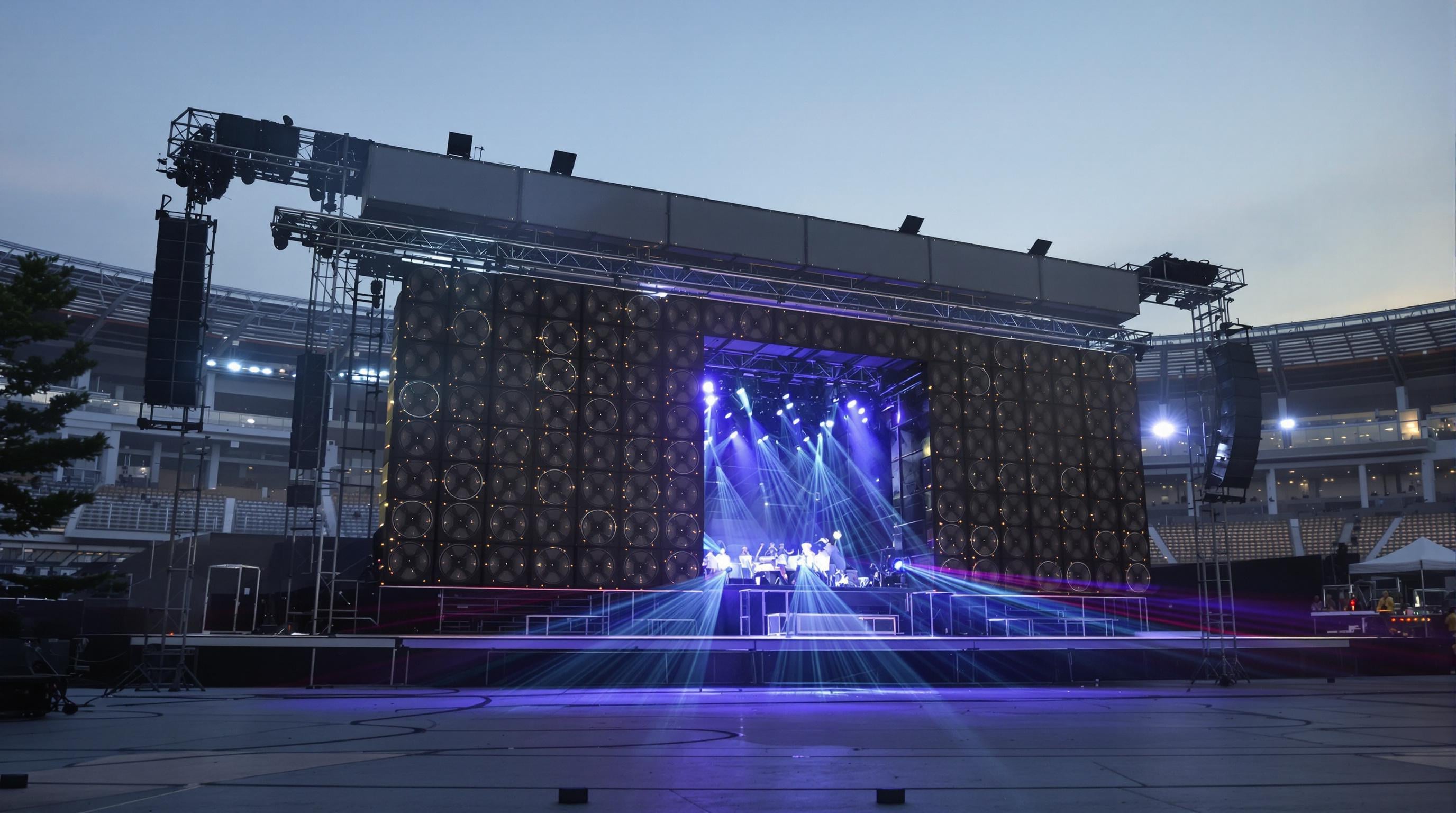
Subwoofer arrays leverage acoustic principles to manipulate low-frequency energy dispersion. Proper design transforms omnidirectional sources into directional systems through wave interference effects scaled by lengthy wavelengths (3.43–11.32m).
Cardioid configurations achieve asymmetric radiation via phase manipulation. Rear-firing subwoofers operate at inverted polarity, creating destructive interference behind the array for front energy summation coupled with rear cancellation. Digital signal processors enable precise phase alignment for frequency-adaptive response correction.
Spacing directly affects wavefront coherence. For 100Hz reproduction (λ=3.43m), elements must stay under 1.7m apart to prevent destructive interference and lobing artifacts. Compact spacing ensures coherent summation across the audience plane.
Physical length defines horizontal beamwidth. Doubling array length reduces beamwidth by 50%, intensifying directionality. An 8m array at 40Hz (λ=8.6m) achieves ±15° coverage—ideal for stadiums requiring focused energy delivery.
Key relationships:
| Parameter | Effect on Radiation | Practical Implication |
|---|---|---|
| Spacing > λ/2 | Destructive lobes | Inconsistent coverage |
| Array length – | Beamwidth – | Enhanced directionality |
| Rear-phase reversal | Cardioid formation | Stage noise reduction |
Vertical stacking of subwoofer cabinets utilizes mutual coupling to amplify low-frequency output, yielding up to 6 dB gain per doubling of cabinets when drivers operate in-phase. Excessive stacking height risks vertical lobing and requires structural verification.
Back-to-back configurations require phase synchronization within 0.1 milliseconds to maintain wavefront coherence. Precise time delays matching enclosure separation distances are essential for effective rear cancellation.
Opening angles between subwoofer pairs dictate horizontal dispersion. Narrow angles (45°-60°) strengthen forward directionality, while wider angles (90°-120°) distribute coverage across broad audience zones, reducing off-axis spill by 5-8 dB.
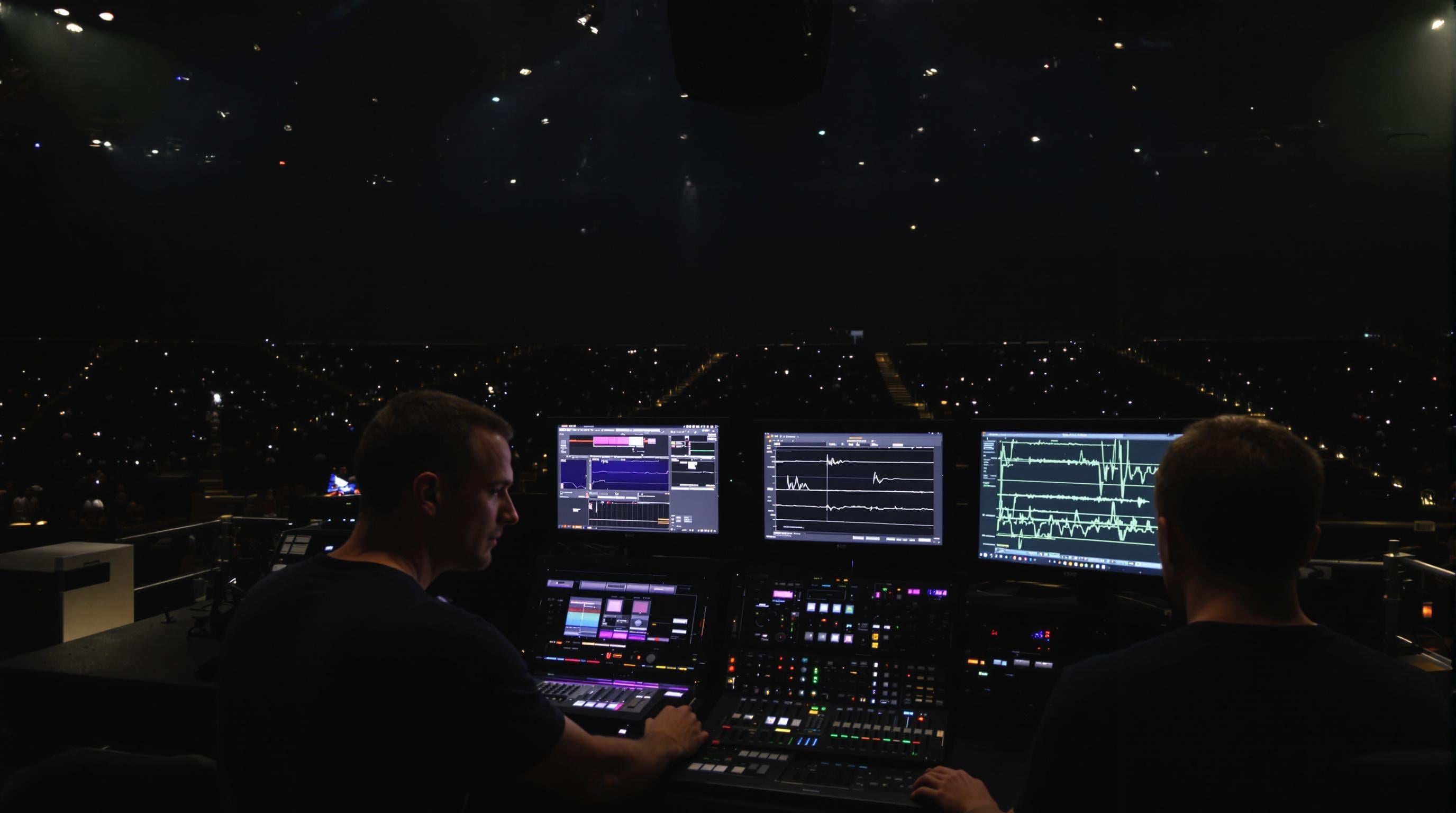
Effective low-frequency control requires precise delay strategies to shape polar responses and enhance forward energy summation.
Modern DSP platforms employ algorithms calculating inter-element delays within 0.5-4ms ranges. Optimized time alignment improves summation efficiency by up to 3dB across 40-100Hz while maintaining phase coherence.
End-fire configurations use cascaded delay times to create virtual source displacements, narrowing horizontal dispersion by 15-20°. This technique benefits long-throw applications but requires careful EQ compensation above 80Hz.
Polarity reversal with quarter-wavelength delays achieves 12-15dB rear cancellation between 40-80Hz. Key parameters include:
BEM simulations model low-frequency wave propagation with 92% accuracy in predicting directional behavior and boundary interactions, per 2023 acoustical engineering studies.
Testing in half-space conditions minimizes environmental reflections, enabling direct comparison between empirical data and simulations.
Cardioid arrays achieve 4.2dB DI at 40Hz, outperforming end-fire configurations by 1.8dB in controlled environments.
Expanding arrays increases output by 3-6dB per doubling but exacerbates phase alignment challenges. Venues needing >120dB output typically see 30-40% reduction in rear rejection efficiency.
Directivity collapses below 50Hz—a 6-element array’s 15° beamwidth at 80Hz becomes omnidirectional below 45Hz. Commercial systems show 10-15dB front/rear variance across 30-100Hz.
Tonal inconsistency emerges when subwoofer arrays couple poorly with full-range systems. Time-alignment challenges create phase deviations exceeding 90°, leading to 8-12dB variance in low-frequency response across venues. Modern solutions increasingly deploy hybrid configurations for coverage versus output zones.
A subwoofer array is a configuration of multiple subwoofer speakers that work together to manage and direct low-frequency sound more effectively than a single subwoofer.
Cardioid subwoofer arrays operate by manipulating the phase of the rear subwoofers, which are set to an inverted polarity, allowing for rear cancellation and front energy summation.
Proper spacing prevents destructive interference and lobing artifacts, ensuring coherent sound wavefronts reach the audience area.
Digital signal processors are used for precise phase alignment and frequency-adaptive response corrections, optimizing the performance of subwoofer arrays.


 EN
EN


 Hot News