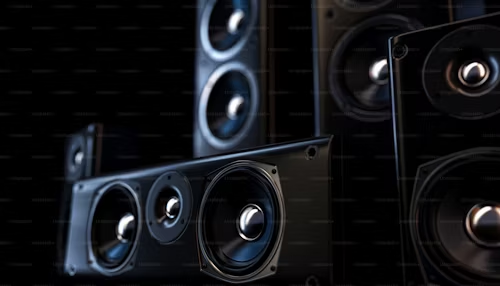
Modern audiences no longer attend live events merely to hear clearly. They expect to be enveloped by sound, to feel dynamic movement, emotional intensity, and spatial depth. The shift from basic reinforcement to immersive storytelling has fundamentally changed how professional stage sound systems are designed and evaluated.
In contemporary productions—whether a large-scale music festival, a theatrical performance, or a branded corporate event—audio quality is inseparable from audience perception. Clarity alone is insufficient. Spatial realism, coverage consistency, tonal balance, and system reliability collectively define the overall experience.
A professional stage sound system is not simply a collection of loudspeakers and amplifiers. It is an integrated ecosystem that combines acoustics, electronics, digital networking, and intelligent control. The design methodology behind the system directly determines whether an audience feels engaged or detached.
As a B2B-focused manufacturer deeply rooted in professional audio engineering, Guangzhou LASE SOUND Co., Ltd. positions itself not only as an equipment supplier, but as a technical partner for immersive production design. In this article, we analyze three critical technological dimensions that define high-performance professional stage sound systems, and demonstrate how scientific system planning can elevate your projects in competitive markets.
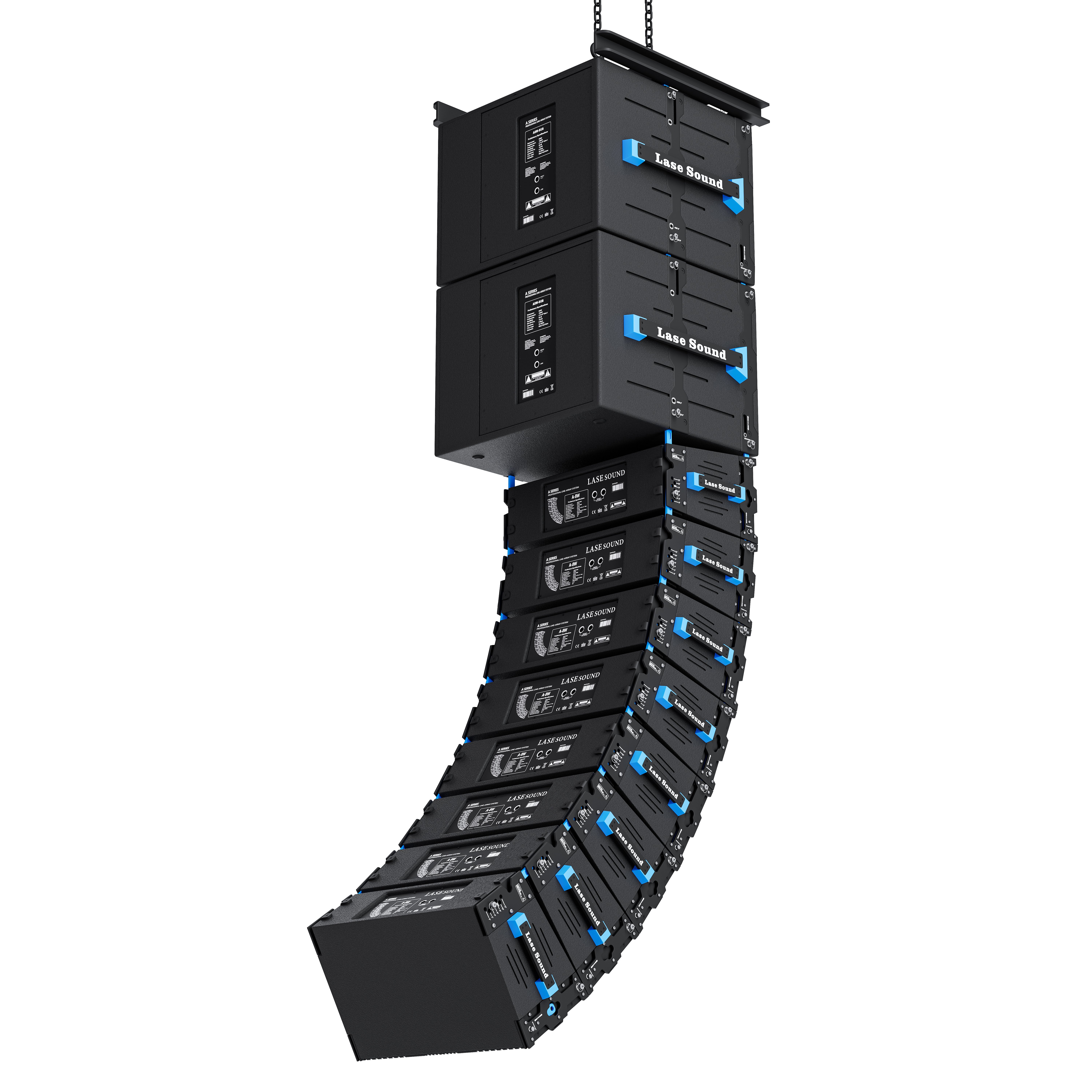
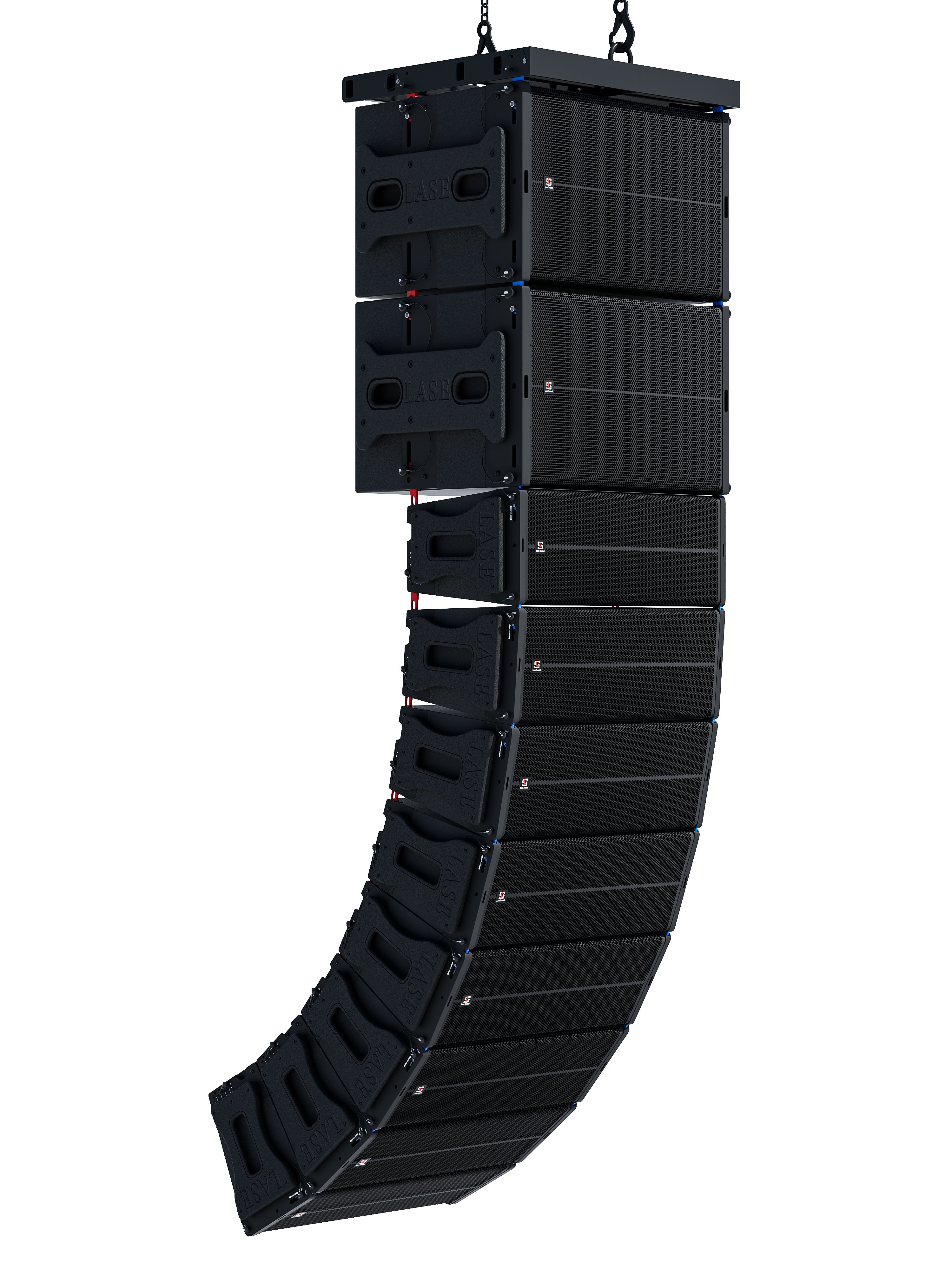
In large-scale applications, line array architecture forms the backbone of modern professional stage sound systems.
The fundamental advantage of a line array lies in controlled directivity. Through vertical coupling and wave interference principles, multiple modules create a narrow vertical dispersion pattern. This allows engineers to project sound precisely toward audience zones while minimizing reflections from ceilings and floors. Reduced unwanted reflections lead to improved intelligibility and higher direct-to-reverberant ratios.
Equally important is long-distance projection capability. When properly configured, line arrays exhibit slower sound pressure level decay over distance compared to traditional point-source clusters. This enables uniform coverage across extensive venues such as stadiums and outdoor festivals. Audience members in rear seating areas receive similar tonal balance and intelligibility as those near the stage.
Phase coherence and mechanical curvature design are critical to performance. Precisely calculated inter-cabinet angles ensure smooth acoustic coupling, minimizing comb filtering artifacts between adjacent elements. This precision enhances clarity and tonal stability across the listening area.
From a business perspective, modular scalability benefits rental companies significantly. The ability to expand or reduce system size based on venue requirements increases asset utilization rates. Dedicated rigging hardware and transport solutions accelerate deployment, reducing labor costs and improving turnaround efficiency.
For large event production providers, line array-based professional stage sound systems offer predictable results, streamlined setup, and consistent performance—factors that directly contribute to client satisfaction and repeat contracts.
While loudspeakers define physical coverage, digital mixing consoles define creative control. In advanced professional stage sound systems, the console acts as the command center, orchestrating signal routing, processing, and real-time adjustments.
Modern digital consoles provide extensive input capacity—often exceeding one hundred channels—combined with comprehensive processing capabilities including parametric equalization, multiband dynamics, and integrated effects. Such processing power accommodates complex productions involving orchestras, multi-band festivals, or multimedia theatrical presentations.
Scene recall and automation functions significantly enhance operational efficiency. Engineers can instantly switch between pre-programmed configurations, dramatically reducing changeover time between acts. This minimizes human error and ensures consistency across performances.
Network audio integration further strengthens system architecture. Built-in AoIP protocols enable seamless connectivity with stage boxes, amplifiers, and monitoring systems. Digital signal distribution reduces analog cabling complexity, decreases potential failure points, and enhances signal integrity.
Remote control capabilities allow engineers to manage the system wirelessly from various audience positions, optimizing tuning accuracy. Multi-user operation supports collaboration between FOH and monitor engineers, enhancing workflow flexibility.
For system integrators and rental providers, integrating digital consoles into professional stage sound systems creates a unified digital ecosystem. Reduced cabling infrastructure, improved signal reliability, and expanded processing capacity translate into operational efficiency and competitive differentiation.
Perhaps the most transformative advancement in recent years is immersive audio processing. Traditional stereo reinforcement distributes sound primarily along a left-right axis. Immersive systems extend this paradigm into a multidimensional spatial field.
Object-based rendering techniques allow individual sound elements to be positioned and moved dynamically within a three-dimensional environment. Instead of fixed channel-based distribution, audio objects are spatially mapped across multiple loudspeaker zones, creating realistic movement and enveloping textures.
Advanced spatial correction and delay compensation tools analyze venue acoustics and generate optimized multi-channel equalization and time alignment parameters. The result is improved listening consistency across seating areas, reducing perceptual discrepancies between central and peripheral zones.
Importantly, immersive processors can often integrate with existing reinforcement infrastructures, reducing upgrade barriers. Compatibility with standard digital consoles and loudspeaker configurations enables gradual system evolution rather than complete replacement.
For high-end venues and production companies seeking differentiation, immersive-enabled professional stage sound systems offer a compelling market advantage. Enhanced audience engagement increases event appeal, attracts premium productions, and strengthens venue branding.
Designing effective professional stage sound systems requires meticulous planning beyond equipment selection.
Acoustic modeling and prediction software play an essential role in optimizing loudspeaker placement and coverage uniformity. Through digital simulation, engineers can evaluate sound pressure distribution, speech intelligibility indices, and potential reflection zones before physical installation. Predictive modeling reduces costly on-site adjustments and improves design accuracy.
Amplifier-loudspeaker matching is equally vital. Sufficient power headroom ensures transient accuracy and minimizes distortion. Integrated DSP processing within amplifiers enables precise crossover management, equalization, and protection parameters tailored to specific loudspeaker models.
Network architecture design must incorporate redundancy. Primary and backup signal paths enhance reliability, particularly for mission-critical events. Future expansion capabilities should also be considered, ensuring scalability without structural redesign.
Electrical distribution and grounding strategies influence noise performance and operational stability. Proper phase allocation and ground loop prevention safeguard signal integrity and reduce unwanted interference.
At Guangzhou LASE SOUND Co., Ltd., our engineering teams support clients in these design phases, offering acoustic consultation, product customization, and system configuration guidance aligned with project objectives.
In large music festivals and touring productions, a combination of line array main systems and immersive processing creates uniform coverage and captivating spatial depth. Such professional stage sound systems enhance sponsor visibility and audience retention by delivering memorable sensory experiences.
In theatres and performing arts venues, digital consoles paired with distributed reinforcement systems ensure precise localization and nuanced tonal reproduction. Enhanced clarity supports dramatic storytelling and artistic authenticity.
Corporate events and product launches benefit from compact line arrays with network-based control, enabling rapid setup and intelligible speech delivery—crucial for brand communication.
Theme parks and cultural tourism installations leverage immersive processing to integrate sound design with visual storytelling, increasing visitor engagement and encouraging repeat attendance.
Across these varied contexts, scientifically designed professional stage sound systems become strategic assets that extend beyond technical infrastructure into experiential branding.
The professional audio industry continues to evolve toward immersive accessibility. What was once reserved for high-budget touring productions is gradually penetrating mid-sized venues, representing a significant growth trajectory over the coming years.
Network-based architectures are becoming standard. Intelligent diagnostics, remote firmware updates, and AI-assisted system optimization are lowering operational complexity while enhancing performance consistency.
Energy efficiency is also shaping procurement decisions. High-efficiency Class D amplification reduces power consumption and heat generation. Environmentally compliant materials and sustainable packaging support global regulatory requirements and align with corporate responsibility objectives.
Manufacturers capable of integrating performance innovation with sustainability and digital intelligence will define the next phase of professional stage sound systems development.
The design of professional stage sound systems has evolved far beyond simple amplification. Today, it represents the convergence of acoustic science, digital networking, and experiential creativity. Proper system architecture transforms live events into immersive journeys that resonate emotionally with audiences.
For rental companies, system integrators, venue operators, and production houses, the right combination of equipment and engineering expertise directly impacts project success, client retention, and market positioning.
With over a decade of experience in professional audio manufacturing, Guangzhou LASE SOUND Co., Ltd. provides a comprehensive portfolio ranging from line array loudspeakers and digital mixing solutions to immersive processing integration. We support OEM and ODM customization, acoustic modeling consultation, and system deployment guidance to ensure each project achieves optimal performance.
We invite you to contact our team for product catalogs, technical documentation, or virtual engineering consultations. Let us collaborate to design professional stage sound systems that move beyond amplification and deliver truly unforgettable immersive audience experiences.


 EN
EN



 Hot News