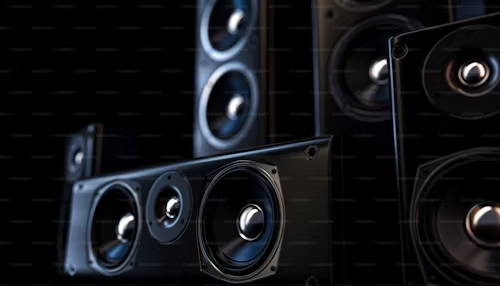
Choosing a professional concert sound system over a standard PA system comes down to dynamic headroom, throw distance, and vocal articulation under heavy acoustic load. This comprehensive engineering guide breaks down real output power, acoustic projection, and distortion control so you can invest in the right live event sound system without costly setup failures.
Power Means Dynamic Headroom, Not Just High Wattage
In a professional concert sound system, true power is measured by clean acoustic headroom and transient fidelity, whereas a standard PA system focuses merely on baseline amplification. When an acoustic act performs, audio peaks are modest. However, a full live band produces explosive transient energy—most notably from the kick drum and snare strike—that requires substantial power reserves to reproduce accurately.
A basic PA system often relies on compact drivers powered by consumer-grade amplifiers pushed close to their thermal thresholds. When pushed by dynamic signals, their built-in limiters clamp down aggressively, producing an audible "pumping" effect that flattens musical dynamics. If driven harder, the amplifiers clip, generating harsh harmonic distortion that fatigues listeners and puts high-frequency diaphragms at risk of thermal burnout.
Conversely, high-output concert sound equipment is engineered with expansive dynamic crest factors. By utilizing heavy-duty voice coils, optimized neodymium motor structures, and high-efficiency class-D amplification modules, these enclosures reproduce sudden transients with visceral physical impact. Instead of struggling at maximum volume, an engineered touring sound system operates comfortably within its linear excursion range, maintaining pristine instrument separation and zero audible clipping throughout hours of high-energy performances.
Clarity Under Pressure: Why Standard PA Systems Sound Muddy Live
Clarity collapses in a standard PA system during live music because multi-source acoustic summing induces severe intermodulation distortion and driver masking. At lower volumes or during pre-recorded playback, a simple two-way portable speaker sounds adequate. However, introducing simultaneous live elements—including multiple vocalists, distorted electric guitars, brass sections, and complex synth patches—dramatically increases acoustic complexity.
In budget PA speakers, standard compression drivers feature narrow throat exits and lightweight voice coils that lose mechanical control when reproducing dense mid-band energy (1 kHz to 4 kHz). This frequency band is precisely where human ear sensitivity peaks and where vocal presence resides. Under concert-level sound pressure, budget diaphragms flex non-linearly, masking lead vocals behind competing rhythm instruments.
A professional concert sound system resolves this through advanced multi-way acoustic geometries, precision crossover networks, and dedicated DSP management. High-performance compression drivers with large titanium or composite diaphragms handle critical mid-range frequencies effortlessly. Advanced FIR (Finite Impulse Response) phase filters align each transducer mechanically and acoustically. The result is distinct separation: vocals project clearly over the mix, rhythm guitars retain bite without harshness, and instruments sit in their intended acoustic space.
| Performance Attribute |
Standard PA System |
Professional Concert Sound System |
| Acoustic Radiator Design |
Point-source conical horn |
Coherent line-source waveguide / Horn array |
| Peak SPL Capability |
118 dB – 126 dB (High distortion) |
134 dB – 144 dB+ (Linear output) |
| Distance Attenuation |
6 dB loss per doubling of distance |
3 dB to 4 dB loss per doubling of distance |
| Low-End Foundation |
45 Hz – 60 Hz (Resonant tuning) |
Sub-30 Hz to 80 Hz (Tight transient response) |
| System Processing |
Basic analog EQ / simple limiters |
Multi-core digital DSP, FIR filters, Delay matrix |
| Structural Rigging |
Basic pole mounts / eyebolts |
Certified multi-point steel rigging frames |
Long-Throw Coverage: Ensuring Front-to-Back Audio Consistency
A professional concert sound system delivers consistent volume across vast audience zones by utilizing controlled cylindrical wave dispersion rather than uncontrolled spherical radiation. Standard point-source boxes radiate sound outwards like a flashlight bulb, following the inverse-square law: sound pressure drops by 6 dB every time distance from the speaker doubles. To push audible vocal volume to an audience member 35 meters back, sound levels in the front rows often reach ear-splitting, unbearable intensities.
Modern concert engineering overcomes this limitation through wave interference control, commonly seen in professional line array speakers. By aligning multiple driver enclosures vertically, sound waves couple constructively along the horizontal plane while cancelling out along the vertical axis:
- Controlled Directivity: Acoustic output is aimed strictly at listening areas, avoiding ceiling reflections, sidewall slap-back, and stage bleed.
- Reduced Distance Drop-off: Cylindrical wavefront propagation cuts SPL decay down to roughly 3 dB per distance doubling in the near-to-mid field.
- Optimized Articulation: Listeners standing 40 meters away experience virtually the same tonal balance, bass response, and vocal articulation as those standing near the front-of-house mixing desk.
- Cardioid Low-End Rejection: Advanced sub-arrays eliminate rear low-frequency energy build-up, maintaining a quiet, feedback-free performance environment on stage for performers.
Low-Frequency Control: Visceral Punch vs. Uncontrolled Boom
Deep, physical bass requires high-excursion concert subwoofers with low power compression, while a standard PA subwoofer simply produces resonant cabinet boom. A standard single 15-inch or 18-inch portable subwoofer is typically tuned with high port resonance to yield an impression of output on paper. However, when hit with fast, successive kick drum hits, the driver cannot recover fast enough, resulting in a loose, one-note rumble that destroys overall mix clarity.
High-output concert subwoofers feature heavy internal bracing, massive magnetic motor assemblies, and high-temperature voice coils capable of 50 mm or greater peak-to-peak excursion. They reproduce the lower octave (30 Hz to 60 Hz) not as boomy noise, but as tight, instantaneous acoustic energy that punches listeners in the chest without muddying the vocal registers. When properly time-aligned to the main tops via digital system processors, the bass section creates a unified, cohesive acoustic experience.
Engineering Reliability: Why Lase Sound Outperforms Conventional Gear
A dependable concert sound system demands specialized industrial manufacturing, precision acoustic enclosures, and rigorous quality verification. Live touring conditions subject loudspeakers to aggressive transit shocks, erratic weather patterns, and grueling 10-hour operating cycles at near-peak capacity. Generic speakers assembled with thin composite plastics or low-density particle board rattle apart and suffer thermal shutdown under these real-world pressures.
This uncompromising operating environment is where LASE SOUND sets the industry benchmark. Backed by an expansive 13,500㎡ manufacturing facility, 286 specialized acoustic technicians, and a global presence spanning over 100 countries, LASE SOUND manufactures systems for mission-critical reliability. Their popular LA-Audio and A-Audio professional line array systems incorporate computer-modeled birch enclosures, precision-machined steel hardware, and advanced DSP network control to handle the demanding acoustic needs of stadiums, arenas, and outdoor festivals worldwide.
System Selection: Evaluating Venue Demands and Production Scale
Deciding between standard PA gear and concert sound equipment requires an honest assessment of room geometry, audience scale, and musical dynamic range. Deploying an oversized concert array in a compact 50-person meeting room introduces phase anomalies and unneeded expense, whereas deploying portable PA gear at a 1,000-person live concert guarantees client dissatisfaction, equipment failure, and distorted audio.
Follow this practical selection framework to establish the proper system class:
- Assess Audience Scale and Venue Geometry: If throw distances exceed 15 meters or crowds exceed 300 standing patrons, standard portable pole-mounted units cannot project clear vocals to the rear; a modular line array speaker system is mandatory.
- Identify Musical Complexity: If the performance involves acoustic instruments or keynote presentations, a premium point-source system may suffice. If full-kit drums, sub-bass synthesizers, and multi-piece rhythm sections are featured, invest in dedicated concert audio equipment.
- Evaluate Power Distribution and Rigging: Full concert systems demand high-amperage, dedicated AC power runs and load-rated overhead truss structures or secure ground-stacking footprints.
- Factor Long-Term ROI: For rental providers and event spaces, premium concert systems command higher booking rates, maintain long-term resale value, and endure rigorous rental cycles with minimal driver failures.
Invest in True Concert-Grade Engineering
High-stakes live performances demand uncompromising acoustic clarity, dynamic authority, and wide sound coverage that a basic standard PA system cannot deliver. Choosing an engineered professional concert sound system ensures your performers project their message clearly, your audience feels the music's full dynamic range, and your production team executes flawless events every single night.
Reach out to LASE SOUND to discuss your upcoming project requirements, receive predictive acoustic system mapping, and explore proven, concert-grade loudspeaker solutions engineered specifically for your venue.


 EN

 Hot News